
Gold, Frankincense and Myrrh for the King of Kings
Or: What Powerful Plant Products and Metals can Reveal
As the story goes, three wise men – or Magi – from the East brought Gold, Frankincense and Myrrh as a gift to Jesus at his birth – when they saw a special star or rather a very rare constellation rising.
Why did they choose those gifts for a newborn in a stable? Why were they so happy that they went to all that trouble for a common baby in a different country and culture, whose parents were simple people? Spoiler: All three gifts, Gold, Frankincense and Myrrh had been extremely valuable and sought after at the time of Jesus’ birth. Normally, they would have been a befitting gift for a prince, not just any baby.
Therefore, the wise men must have regarded Jesus as very very important, and they based that on their astronomical and astrological observations alone. Astrology was a well respected ancient science back then and would justify the long journey the took on themselves.
But why did they choose those three gifts? What kind of trinity is this? As scientists at that time, they also would have known about natural sciences, about medicine and the use of herbs, metals and resins for healing purposes. Therefore, the Magi wouldn’t have chosen random gifts, but chosen wisely and with great consideration.
They wouldn’t have given valuable gifts to honor what they had seen in the stars, but present gifts that would signify what exactly they had seen. They knew about the powerful symbolism of nature’s gifts. Let’s see what we can come up with in form of an explanation. But surely, these gifts were more than promoting Jesus’ health and prosperity.
But first, here is what happened according to the Bible:
“When they saw the star, they rejoiced exceedingly with great joy. After coming into the house they saw the Child with Mary His mother; and they fell to the ground and worshiped Him. Then, opening their treasures, they presented to Him gifts of gold, frankincense, and myrrh.” (Matthew 2:10-11)
Who is This Newborn Child?
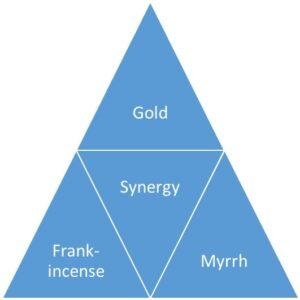
Three aspects combined show Jesus’ (enternal) life purpose:
Gold as an Offering to Jesus at his Birth in Bethlehem
How was Gold used before AD 0? Was it normal to travel a long way through the desert to give it to someone? It is certain that Gold had been used in all ancient civilizations for millennia. Around the year 0 (AD), it was mainly a symbol of wealth and power, and was of course popular as material for Jewellry, and coins.
In Egypt, gold had been known as the “skin of the Gods” and was used for sacred objects – and by powerful Pharaoes. Similarly, gold was often used for kings and in temples in all parts of the ancient world – in Hebrew tradition, the Holy of Holies (the Inner Temple) was fitted with Gold entirely.
The wise men were most likely from Persia or Babylonia though: In most ancient “pagan” cultures and later, Gold is regarded as the metal of the Sun. In alchemy for example, a sun is the symbol for gold. But also many ancient main (most powerful) Gods and Goddesses were associated with the sun and gold.
In fact, the latin name for Gold, aurum, and also the Sanskrit root (including for Celtic languages) are connected with “sun”, in particular the forever rising sun (Aurora – the golden dawn), which is a spiritual concept.
Gold has been regarded as an eternal metal, as it does not tarnish or errode. It was used therefore as material in the building of pyramids, temples, and palaces. At the time of the Romans, it was also used in form of gold coins, and of course was popular amongst the powerful, rich and ruling class.
In medieval times, in Ayurveda, and today, Gold was and is certainly used for healing purposes, but I have currently no information if that was a widespread use A.D., or the first thing that would have come to mind.
Why was Gold Given as a Gift to Jesus Therefore?
Giving gold to baby Jesus meant attributing to him (without having any other external reason to do so, whatsoever) top king status, eternal power, status of a Sun God, and wealth. Gold has always been associated with purity and eternity.
In direct Jewish tradition, Gold signifies the Holy. The Holiest of Holy, in fact. Gifting Gold means attributing to baby Jesus the status of a holy king. Of the highest King of Kings, in eternity. As the holy temple was used for worship of God of course, and all objects in the innermost part were said to be of pure Gold, it also hints to the lineage Jesus was born a King of. Spiritually, it shows the direct connection to God.
Frankincense as a Gift for Baby Jesus at his Birth
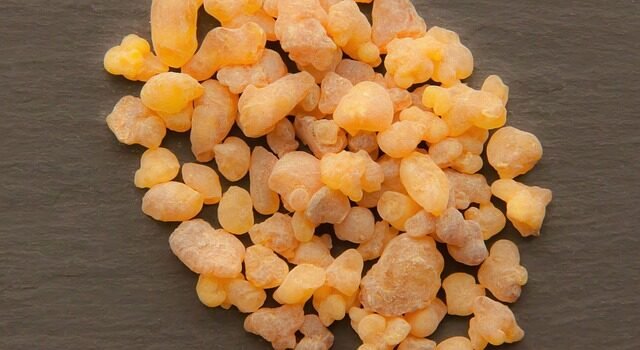
Frankincense (olibanum) is an aromatic resin, traditionally used as incense and in perfumes, but also for healing purposes. It is extremely aromatic and is used in orthodox churches even today. At the time of Jesus’ birth, it was valuable in itself, as it was so popular that a whole incense trading route had been established between the Arabic and Eastern part of the ancient world, and the “Western” world. Since long before Jesus’ birth, but flourishing at the time of the Roman empire for sure.
Healing properties of Frankincense had been regarded a known fact back then, too, also in all parts of the ancient world. In Egypt for example, it was unthinkable not to include Frankincense in rites and medicine. The Egyptian Papyrus Ebers (1500 BC) recommends Frankincense for throat infections and asthma and it was reportedly used for other ailments and wounds, too. It is also said to have antimicrobial properties. Frankincense and myrrh were even used in a balm for mummification. Egyptian Kings were said to connect with the realm of Gods through the use of incense.
Frankincense was used in ancient times in temples around the world, as an offer to the Gods, and also to enhance the direct relationship to the higher power.
The True Meaning of the First Christmas Present
But what did it mean that the wisemen chose frankincense to present to Jesus? Did they want to make sure, his health would be looked after? Was it simply a luxury item?
As Frankincense had been used as an offering to God or the Gods in all known ancient cultures at the time of Jesus’ birth, and is mentioned to establish the connection to the Higher Being, I think it is safe to say that this is the main meaning of this first Christmas present: Frankincense shows Jesus’ spiritual role – the way to God.
Frankincense in direct Jewish and Biblical tradition
Long before the Birth of Jesus, the Bible reports that “God” gave a particular formula for the incense to be burned on the altar of incense to Moses: “Take for yourself spices, stacte and onycha and galbanum, spices with pure frankincense; there shall be an equal part of each. With it you shall make incense, (…), it shall be most holy to you. The incense which you shall make, you shall not make in the same proportions for yourselves; it shall be holy to you for the LORD.” – Ex. 30:34-38
It is noteworthy that frankincense only is described as “pure”. But more importantly: this special incense blend containing frankincense is described as “most holy” (Ex. 30:36): Kodesh Kodashim – holy of holies.
The Third Part of the Original Christmas Gift: Myrrh
Myrrh was used in incense, in perfumes and rituals often in a similar fashion as frankincense. Is it the exact same kind of gift to Jesus therefore? Myrrh is also a resin (or gum) from a tree, and has been used as incense since earliest reported times all over the ancient world.
Same as Frankincense, Myrrh was a costly substance in ancient times, and people went to great length to obtain it. Those who could offer it in trade got wealthy, and myths were created to keep people away from the trees to saveguard the priced resin. The trees were said to be protected by winged snakes, for example.
Myrrh is mentioned in Sumerian inscriptions, in the Egyptian Ebers papyrus and in Greek writings as medicine for different ailments, and it is also mentioned for cleaning cosmetic purposes.
Myrrh was regarded as sacred in many cultures
What sets Myrrh apart though, is its use in funeral ceremonies, not only in Egypt or India, but also in Biblical tradition. Myrrh is also mentioned at the death of Christ, as part of a wine offered to him.
In Egypt, it was also part of the incense in temples and rituals, and part of medicine. The ancient Egyptians regarded Myrrh as the tears of Horus, the falcon-headed sun god. In Hermeticism, this would be a direct reference to Jesus and his role in the holy trinity, too. Myrrh was used in mummification in Egypt. The name in Ancient Egypt was punt or phun, it was part of the sacred incense Kyphi.
Myrrh was used in salves and ointments in ancient Greek and Rome, too, known for its antiseptic and anticatarrhal properties.
Myrrh in the Biblical Context
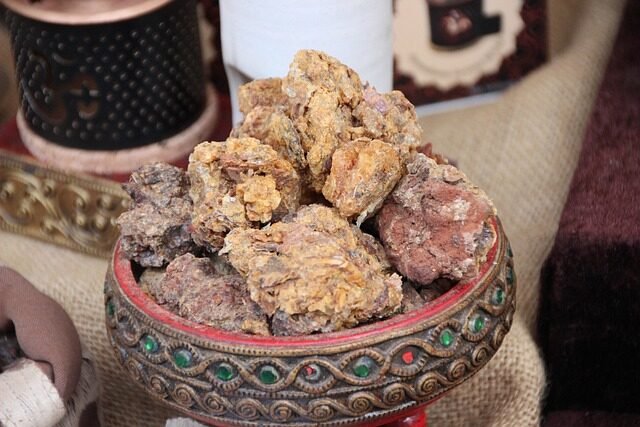
But back to the direct Biblical context: as early as Moses, myrrh is mentioned in the Bible. Moses was given instructions for preparing incense from myrrh and cedarwood.
In Hebrew tradition, Myrrh is part of the holy anointing oil and of the temple incense mixture Ketoret. Myrrh infused wine was consumed before rituals to raise consciousness.
Speaking of which: Both Frankincense and Myrrh used as incense have an effect on the human mind, and promote a trancelike state (when exposed to intense smoke for a prolonged period of time) – therefore used to open people up for the connection to the higher being.
The Old Testament mentions: “the LORD spoke to Moses, saying, “Take also for yourself the finest of spices: of flowing myrrh five hundred shekels, and of fragrant cinnamon half as much, two hundred and fifty, and of fragrant cane two hundred and fifty, and of cassia five hundred, according to the shekel of the sanctuary, and of olive oil a hin. You shall make of these a holy anointing oil, a perfume mixture, the work of a perfumer; it shall be a holy anointing oil…”.” (Ex. 30:22-25)
In Jewish tradtion, myrrh is reserved for worship, and in form of a holy anointing oil used to consecrate all of the objects and tools of the Tabernacle along with the priests: Objects and priests would be regarded as holy afterwards: “You shall also consecrate them, that they may be most holy; whatever touches them shall be holy.”
Literally: “most holy”: Kodesh Kodashim – holy of holies, meaning “holy to the LORD, – for His service alone”. As was Jesus role, purpose and destiny so to speak.
In Essence
Personally, I find it interesting that the very birth of Jesus and his given role from birth, is justified by ancient astrology. As Astrology might be part of the Kabbalistic tradition, but normally not of the Christian one.
Direct tradition or Biblical context points directly to the “Holiest of Holy”, the Inner Temple. In Hermeticism, this is to be taken figuratively – it is our Innermost Self, our own spiritual connection with our Higher Self, or the ONE Higher Being. As Myrrh as “the tears of Horus” shows – Jesus is part of the Holy Trinity, which became in Christianity of course Father – Son – Spirit, but there is also the Hermetic counterpart of Isis – Osiris – Horus. (Horus being the son of Isis and Osiris). Myrrh for example is also mentioned as an incense dedicated to her, her skin is Golden, of course, and Frankincense is more or less omnipresent.
The birth of Jesus in the story of the wise men presenting gifts based of their astronomical observations is most peculiar viewed from the viewpoint of Christian tradition as I have been brought up in. I like Eastern Orthodox churches and services very much, especially because of the use of incense, and there is a LOT of Gold. There are also often symbols of a trinity present.
It is often said that the gifts to Jesus have the following meaning: Gold signifying his status as “King”, frankincense showing his “priesthood” or spiritual significance, and myrrh pointing to his role in death (or rather dying).
The three Magi therefore express in symbolic gifts Jesus lifepath, his role, his significance. They present his “destiny” to him, as good astrologers do. They validate and justify his role as son of God. I find it most noteworthy that these three prosperous, scholared ancient scientists named “Magi” (magicians) come from a non-Hebrew place, to show in the accounts of the New Testament to future Christians who Jesus is. They were from a pagan, polytheistic culture, and most were worshipping a Sun God at that time. But they give Jesus highest status.
I personally see therefore also this connection: “Christmas” as it is celebrated today in Christianity at the time of the Winter Solstice (mostly December 21st), was an attempt to assimilate pagan Sun or Sun God worship tradition. At the time of Jesus’ birth, when Jerusalem was occupied by the Romans, there was a lot of Sun God worship. Also from any other old traditions from neighbouring cultures, in fact. Yahweh (some researchers believe) might have been a Sun God himself in very early times.
Gold, combined with Frankincense and Myrrh, points to the (re)birth of the rising and forever new and spiritual Sun with undiminished power and life energy.
Or to explain in even more Eastern terms, as maybe the Magi from the Orient were even from India and worshipped the Sun God Surya, we will never know:
Pavamana Mantra: Asato ma, Sadgamaya
Lead me from the untruth to the Truth.
Lead me from darkness to light.
Lead me from death to immortality
Om Peace Peace Peace.
“I am the way and the truth and the life. No one comes to the Father except through me.”
John 14:6
*Frankincense – Boswellia
Family: burseraceae
Boswellia sacra: from south Arabia, nuia
Drug: olibanum, gum olibanum, frankincense, gum or resin of the plant.
Compounds: essential oil 5-9 percent, with pinen, dipenten and others, resin 60-66 percent, esp. Boswellia acid , gum 20 %, bassorin, bitter compounds, mucilage
Use: as medicinal plaster, incense for worship, essential oil for perfume, and cosmetics.
Boswellia serrata: India.
Important compounds: essential oil, mucilage, resin, Serratol.
Use: in Indian traditional medicine used for arthritis, rheumatism, bronchial asthma, diarrhoea, … in ayurvedic medicine, for blood and skin disease, diabetes, fever, etc.