
Herbs, Evergreens, and Incense for Winter Solstice
The longest night of the year at Winter Solstice (around the 21st of December) also known as Yule or Jul was an essential celebration in many pagan cultures. In fact, what the Western world celebrates as “Christmas” had assimilated the ancient celebrations of the winter solstice, often marking the beginning of the New Year. Plants, especially evergreens or conifers, herbs and incense had always had their place in Yule or Jul lore, and many Christmas decorations and traditions are based on certain pagan traditions. Which are they?
Winter Solstice: Revolving around the Rebirth of Light
Most symbolism found in traditional Winter Solstice (and Christmas) traditions and decorations revolve around “rebirth”, “eternal life”, “neverending cycle”, or “light”. Jul is supposed to mean “wheel of the Sun”. The Roman historian Plinius reported about 2000 years ago that the norsemen would send their spies to the montain tops at mid winter night to watch out for the returning sun. Then there was tremendous joy and jubilation and people celebrated the joyous message of the light. But this message wasn’t only conveyed by fires lit on mountain tops:
Evergreen Wreaths, Bundles, Twigs, and Trees
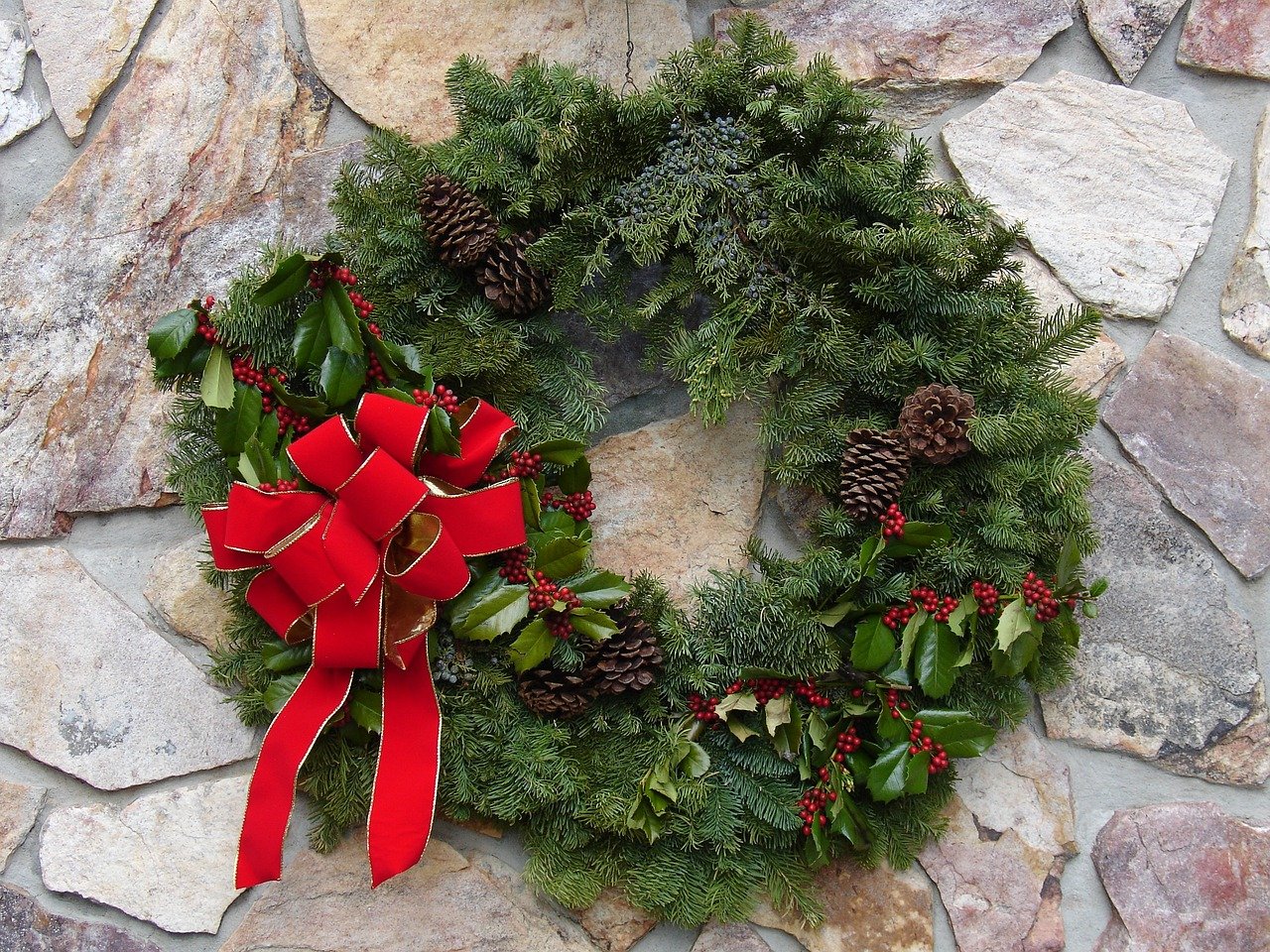
Let’s start with evergreen wreaths, as they symbolize the meaning of the Winter Solstice best. Christmas trees and Christmas wraths have nothing to do with Christianity or the Bible whatsoever, I am sorry to say. When the church spread new customs and traditions across Europe some 1500 years ago, it met with deep seated pagan traditions which weren’t easy to forbid or to fight, even when people were beheaded or hung when caught celebrating pagan holidays. A much easier and more successful way therefore was the tried method of the Roman Empire: Assimilate. This happened around the 4th century regarding “Christmas” and the use of Evergreens in Christmas lore is one of the best examples.
Evergreens and especially wreaths and wheels were a custom around Yule or Winter Solstice in many pagan traditions, such as Celtic, Slavic, Nordic (Norse) and Germanic. For example: Wheels (often wrapped with straw or made entirely of straw) were set on fire on a hill top and rolled downhill (often to a river). This was mostly said to assure fertility of the fields, and could also happen at the end of winter.
Twigs and wreaths made of evergreens symbolize eternal life, and the eternal life cycle as well as the wheel of the year. A ring, circle or wrath always has to do with eternity and immortality or eternal rebirth (renewal), or eternal youth. When everything else was practically dying in winter in Europe, evergreens stayed green and fertile – hence their use. I am not sure about the Christian tradition to put candles on a wrath for the table – but fire and light certainly do stem from the winter solstice, too, see below.
To observe the celebrations marked by the wheel of the year was of great importance in ancient cultures who were relying on nature for survival. The eight spoked wheel of the year can be found as a symbol carved into megalithic stones, in many places.
The four sun markings are the most important ones: The year begins with the Winter Solstice, the shortest day of the year. From this day onwards, the light grows again and rebirth of nature will be possible. Followed by the spring equinox around march 21st, when day and night are in balance, then summer solstice around June 21st and autumn (fall) equinox around the 21st of September. The other four important dates are actually based on the moon cycle, and mark important times in between each of the four sun celebrations. Sun and Moon, Earth and Sky (light), aren’t only important symbols for heathens, but were most crucial for survival when foraging and growing food: to watch the sun, moon and stars was crucial for a successful harvest, to know when to sew, which work to do at which time, and to monitor and prepare.
Trees, such as the Christmas tree, with lights, is not really a pagan tradition, but most likely united the pagan tree symbolism with the light symbolism: The 21st of December, the winter solstice, marks the rebirth of the sun, the coming of light into the world. This is what connected Christianity and Jesus’ birth to the old traditions. Holy tree symbolism is found in all pagan traditions, and there is also the Jul log – a tree stem or huge log, cut from the forest especially for the winter solstice. Some traditions say it must be oak, others yew, … either way, it is dried for one year at the fireplace, and then used to rekindle the new fire in the hearth. It is reported for some traditions that all fires and lights were put out during the Yule night, and then relighted at sunrise. A fire in the hearth was most important, and was never supposed to go out during winter, as it was the one and only source of light and heat and of course for cooking.
The importance of the main dates on the wheel of the year is not to be unterestimated: from Egyptians, over Stone Age, Germanic and Celtic monuments up to freemasonry architecture, astronomy – most important monuments and buildings are based on the position of the sun at exact times of the year. From Newgrange in Ireland where the light falls through an opening and illuminating a certain part of the inner building at the exact time of sun rise and winter solstice, over Stonehenge and similar sites, to pyramids , the Sphinx, and churches – those are all set for the exact position according to the position of the sun most often at a solstice of equinox and/or specific star constellations, i. e. the position of the stars at a certain time of the year. Even the oldest holy stone age sites and other ancient stones / megaliths and artifacts often show astronomical markings and sun/star maps or symbols.
Plants, Herbs & Spices used at Winter Solstice
I like to hear and read about traditions, and folklore tales about the use of herbs or plants, as their origin most likely dates back thousands of years. The following is from varied sources, and it is not always clear how historical correct they are. Many traditions were passed on orally, and never written down.
Evergreens at Winter Solstice or Yule
Remember: evergreens always represent eternal life as they don’t seem to “die” in the winter as other trees.
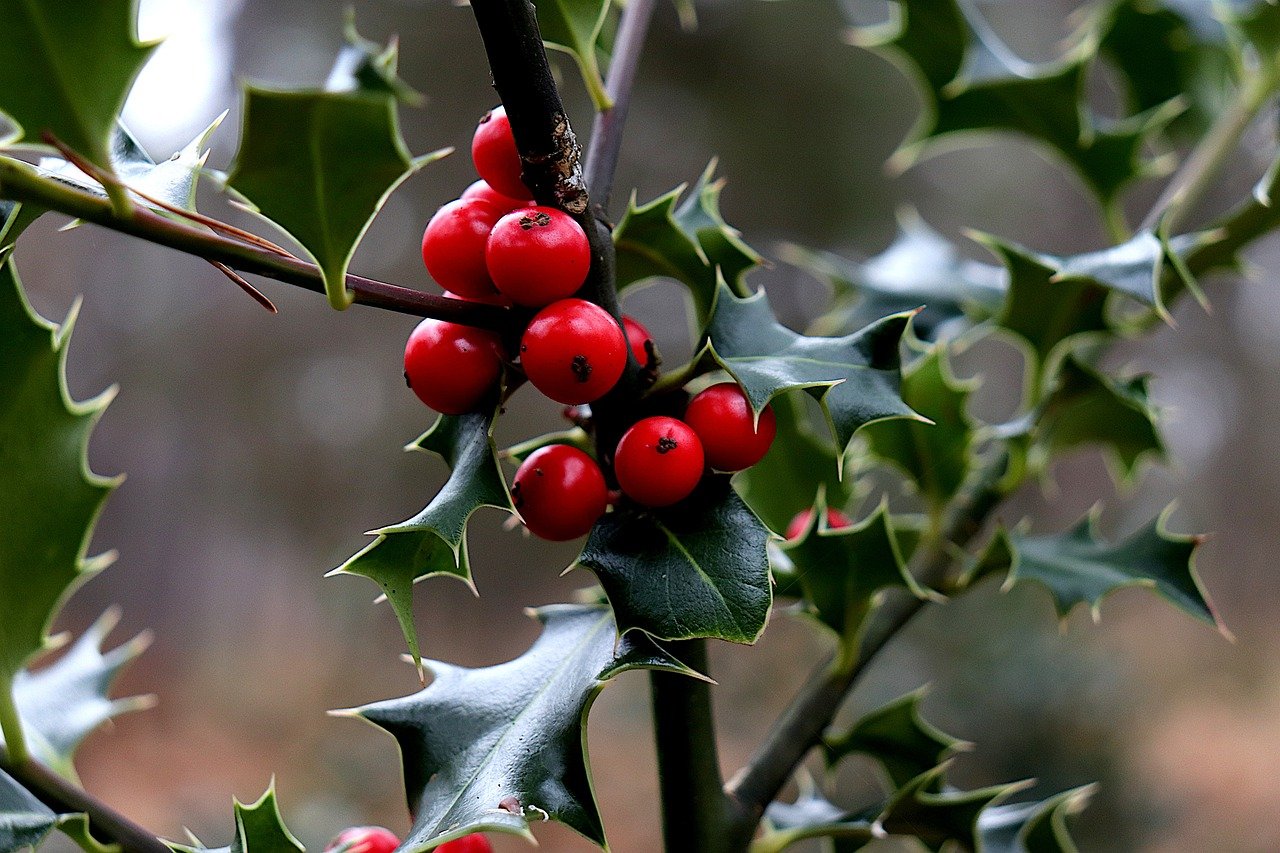
Holly (European holly, Ilex aquifolium)
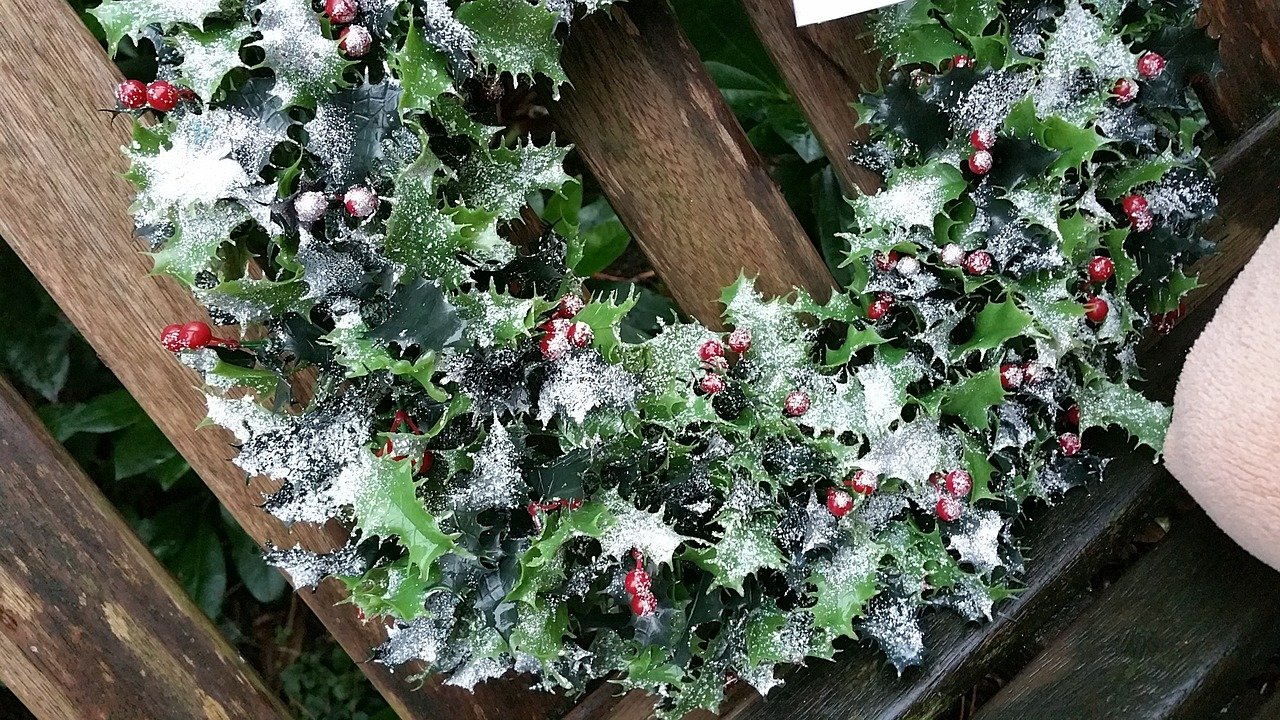
Celtic Druids supposedly used leaves of holly for protection. (Holly is certainly a medicinal plant, but do not consume the leaves just like that, they contain some potentially toxic substances. Do not eat the berries and keep children away from them.)
Use: use Holly leaves or twigs as decoration, they are often part of evergreen wraths. They stay nice and green for a while.
Fir
The classical Christmas tree is a Fir, which has also practical reasons, as its twigs have a more favorable form and stability for this use.
Firs (Abies) comprise around 50 species of evergreens in the family Pinaceae. The name is derived from the Latin “to rise” in reference to the height of its species. The English name is ralated to Nordic fyri or fyr.
Use: one doesn’t have to kill a fir and use as as a christmas tree, one can also use some twigs for decoration and for an evergreen wrath. In addition, fir needles can be used as tea or can be used as food, too. Resin and essential oils can be used for incense and aroma therapy, though other conifers are more common for this use.
Read the original study letter on Conifers for recipes for fir tea.
Pine
Please see the article on pines for its uses. Pines combrise many species, they are found all over the norther hemisphere and are a valuable medicinal plant. They do not make the best Christmas trees or twigs for decoration, use sparingly as an add-on for decorational use. The needles can be used for a tea, and other uses are oil of turpentine and essential pine oil.
Mistletoe
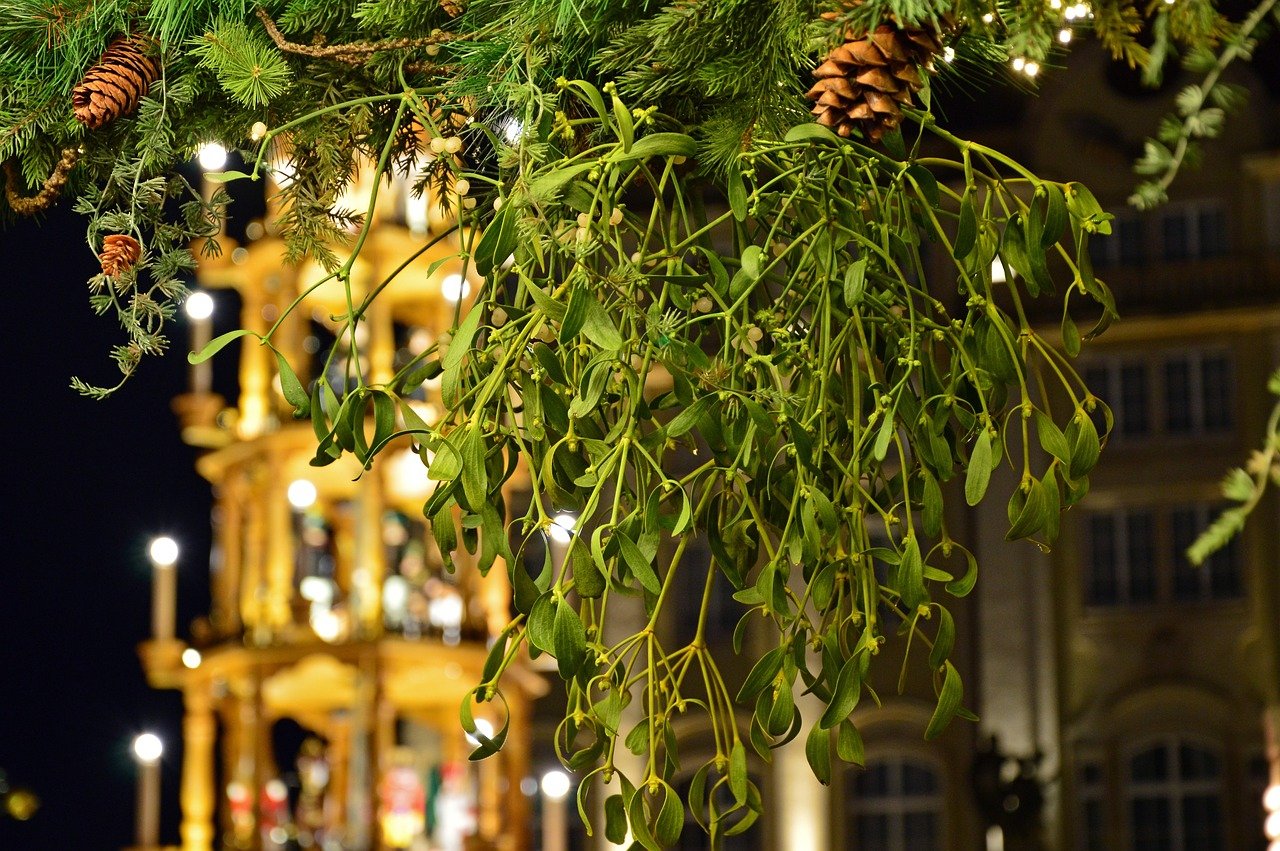
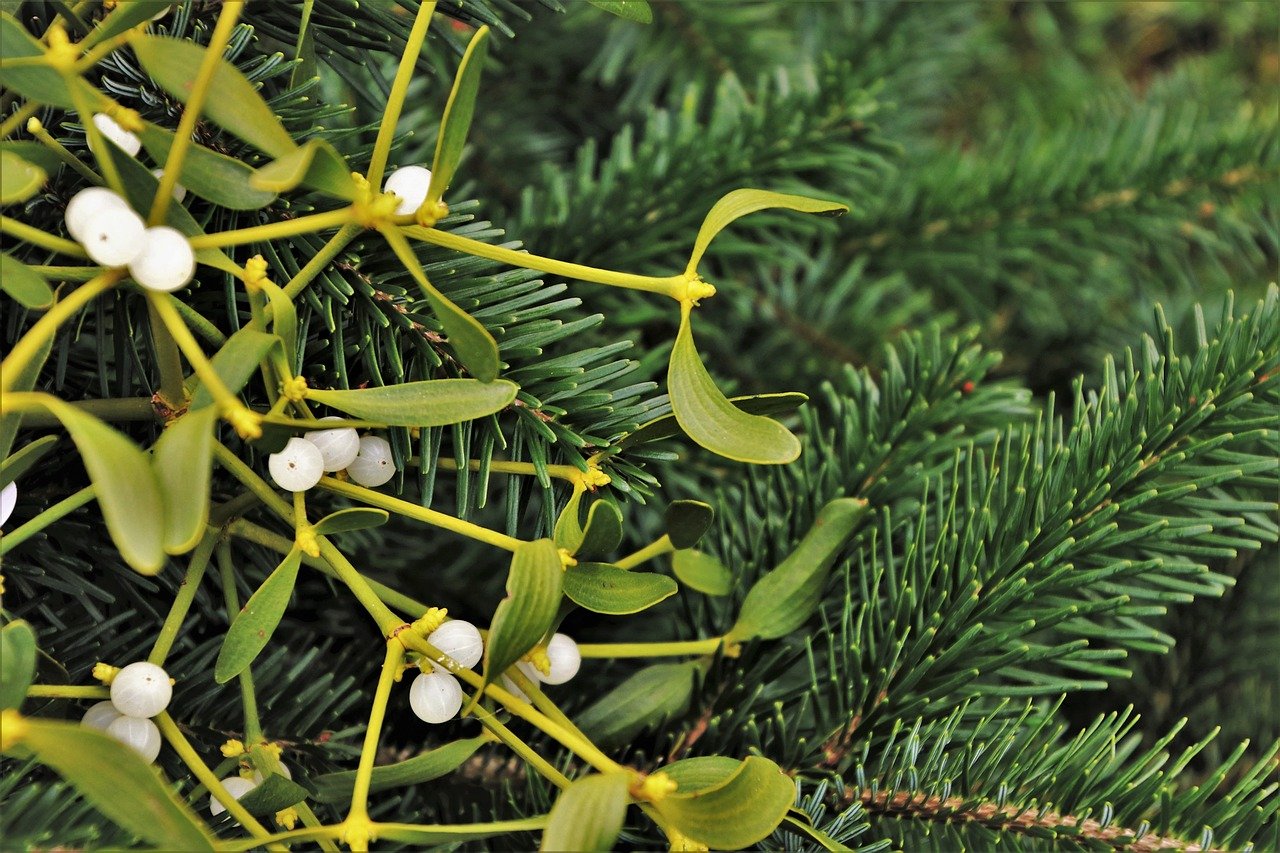
The list of the uses of and the traditions around mistletoe is very long and complex. Mistletoe is said to be one of the holy herbs of the Druids, and in Celtic tradition in general. They are connected to eternal life. Mistletoe is widely used for decoration in the holiday season. But it is also a potent medicinal plant, some people say that mistletoe tea (and other preparations, even injections) can be used for cancer, for example. The Druids are known to have used mistletoe for healing, already.
The Asterix stories of Getafix (French original: Panoramix; German version: Miraculix), cutting mistletoe with a golden sickle sitting in oak trees, are actually based on real life accounts of Roman historians. It was reported that Druids climbed oak trees around the winter solstice to cut mistletoe with a golden sickle, as the oak was holy, too, and mistletoe growing (as a parasitic plant) on an oak were viewed holy, too. Young people were then sent around with the mistletoe to announce the new year. Even today, it is often customary to hang a fresh bundle of mistletoe above the door for protection and good luck, and remove the old one from last year.
In Celtic and many other traditions, the mistletoe wasn’t only associated with eternal life, but also with fertility, some say that Druids used mistletoe to make an elixir to protect against poisons and to resolve infertility.
But we have also accounts from other ancient cultures, norse mythology reports that mistletoe was regarded as a symbol for love and peace. Figg or Frigga lost her son Baldur to an arrow made of mistletoe. In fact, the mistletoe had refused to make promises to her before. So, then Frigga is said to have vowed that Mistletoe would never be used as a weapon again, but to kiss anyone passing underneath it.
Kissing under the mistletoe was also a tradition in ancient Greece during the Saturnalia. It was also used at wedding ceremonies. Romans used mistletoe as a decoration around mid winter as well.
Juniper
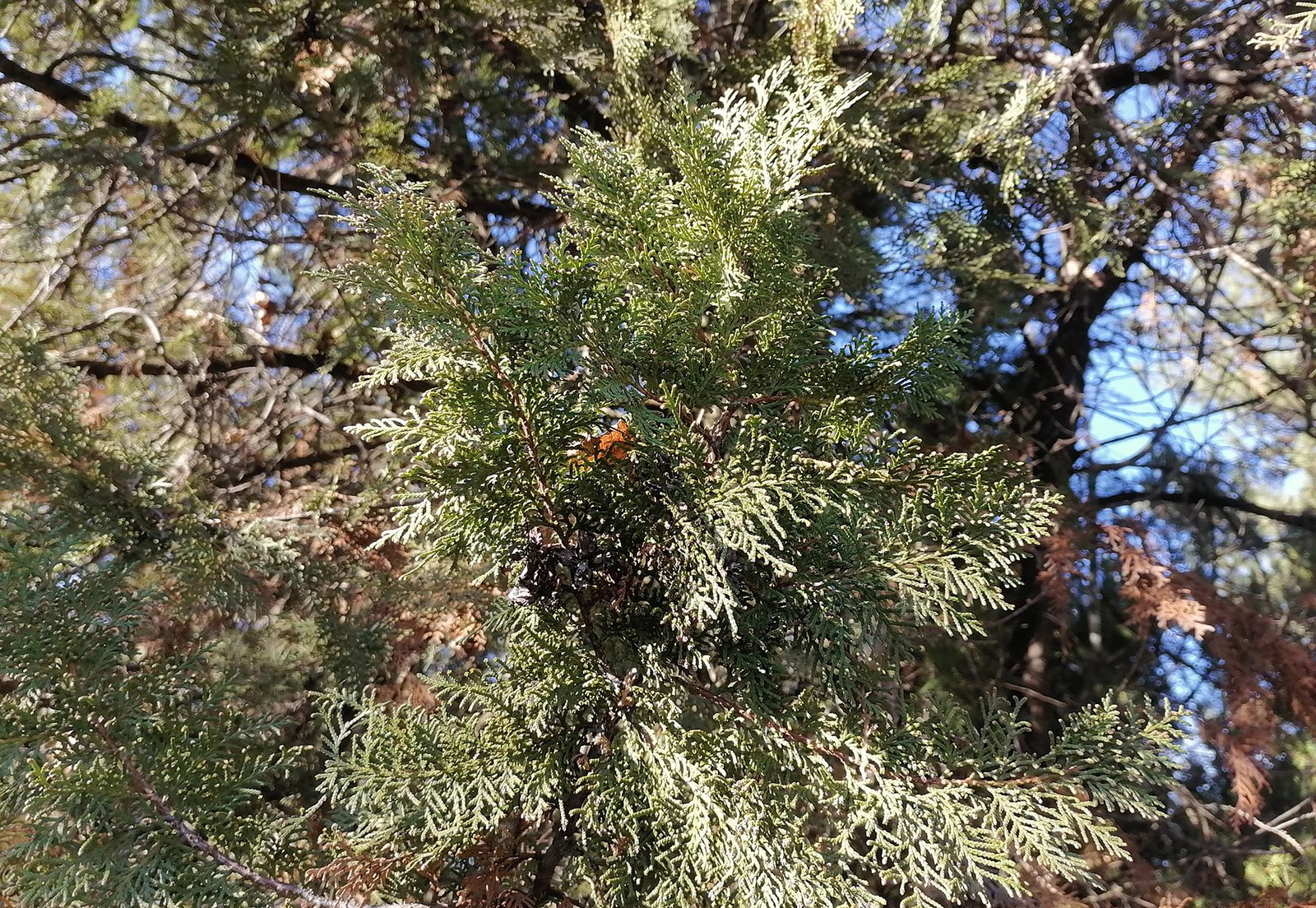
Juniper is traditionally used in Scottish and Gaelic rites at New Year, where incense from juniper is used to cleanse, bless, and protect the household and its inhabitants. This threefold ritual is found in the same way, passed on over many generation in other parts of Europe, for example in Austria, where also the whole family came together to use incense from Juniper to first cleanse the house, then give balance or strength, and finally protect it. The family also surrounded the house and the stables in a circle outside for protection.
A tea can be made from the young twigs. Juniper as incense, for decoration, and essential oils are traditionally used in Yule lore and still today in traditional holiday customs. Use the twigs or “leaves” in an evergreen wrath, and use resin as incense.
Juniper berry
Juniper berries are best known for medicinal use, in form of tea for example. But they are also used as a spice and are well known for lending their flavor to gin (and also their name, as “gin” is short for the Dutch word for juniper: jenever).
Please view here the orginal study letter on evergreens / conifers, to learn how to use juniper berries for tea, and also about essential juniper oil.
Ivy
Often a symbol of eternity, ivy is often used in evergreen wraths, though not always around Christmas. Ivy is a strong medicinal plant, too, more often than not used topically (externally) though or in preparations such as sirup. There are many, many accounts of traditional use of ivy, we will describe another time.
Yew
The Yew tree is also said to be a symbol of eternal life, the tree grows slowly and regnerates itself – over several generations. In mythology therefore, yew is connected to eternal life, rebirth, and ancestors. It was a holy tree in many pagan cultures. Some say, the Jul log must be of the Yew tree.
Careful: yew berries, leaves (or needles) and bark can be toxic, do NOT use as tea and such, unless you know what you are doing. Do NOT burn the leaves or use a incense, use the solid wood only for a fire.
What about spices we often associate with Christmas, like gingerbread, cinnemon, cloves ….?
With the exception of ancient Roman, Greek, etc. traditions, oriental spices were of course not used in Germanic or Celtic traditions. Yes, spices were used in bread and in drinks, such as hot milk and hot met / med / medh (honey wine), or even beer, must not the ones we know today in mulled red wine and such. Those were known by the Romans, etc., and in the Middle Ages – hence more popular across Europe in Christian times – in other words, spices associated with Christmas are really a tradition from the Christian era, or from rituals in the Eastern or mediterranean world.
Mulled Wine & Met / Med
Hot Met or Med, best known from Germanic or Slavic people. In Germanic tradition, Met was sacrificed by pouring a bit into the Earth, for example at a fire ceremony. Every person also took a sip. Herbs and spices in wine and Met are a long standing traditional use of herbs, with long Germanic tradition, as options in early times to use and preserve herbs as medicine were limited to wine, tea, or use with honey / milk. But local herbs and spices of course.
Yes, we all love Rudolph, but whose sleigh in the sky was it originally?
I don’t want to go deeply into the origin of the story of Rudolph, reindeers, and Father Christmas, I just want to mention that the sleigh or wagon in the sky seen at Christmas Eve is also of pagan origin, most prominently in Germanic and Nordic / Norse lore.
In Germanic tradition, this is Odin’s wagon, used to ride with his hordes over the frosty winter land, bringing with him the souls of the dead. Hence the icy winter storms, and the use of incense at Christmas time, originally at winter solstice and the following 12 nights. The Germanic year ends at Winter Solstice and starts again 12 days later (while the Celtic year ends at Samhuin (Halloween, around 31st of October) and starts with the rebirth of the Sun at Winter Solstice / Yule.
The wagon in the sky is also found in Egyptian mythology, and is a reference to the Sun.
The “Rauhnächte” end after 11 days or 12 nights. Again, we find this assimilated into a Christian custom: in Western Europe it is often customary to keep Christmas Trees and Christmas decorations up till the 6th of January (Epiphany, day of the 3 Wisemen or “kings”), and even today, in Germany, this time (though today often meaning the days between Christmas and the 1st of Jan.) is still referred to the time “between the years”.
Either way, it is a cold, rough time in nature, but a time for calm and insight – and the light – within, as work and negotiatons are supposed to cease. In Germanic mythology, it is said that all work of the year must be finished and in good order before the 21st of December, or Holle or Hulda / Hel will confuse everything for another whole year. The 12 following nights are nights of rest and celebration, some say, one day for each month of the year.
Germanic mythology also knows the tale of Odin’s sons revenging his death, resulting in rebirth or reincarnation of Odin, and symbolizing the victory of light over darkness.
Side note: the 12 nights are said to make up the difference between the sun and the moon year, both of Germanic importance.
Some say that this was a time where each night symblized one month of the coming year and were used for divination.
Odin’s wild hunt … and Incense.
We tend to associate “white christmas”, and certain smells with the holiday season: it is not only a celebration, it actually comprises all senses for a whole “season”, which is probably what makes this time so special to us. Incense played a special role at winter solstice time, too:
Odin is said to carry the souls of the dead on his sleigh, therefore, bread, food and beverages are put out for the Gods, and light and incense for the dead. House and stables are purified by Juniper incense, to remove all bad and evil from the past year, and also bring home the souls of ancestors.
Since celebrating the birth of Jesus, Frankincense and Myrrhe are often associated with this time of year, traditional pagan incense for cleansing at Winter Solstice though would be Juniper, mugwort, spruce and pine resin. Traditional German incense cones found at traditional Christmas markets (and in shops), for example, would more often have the “Christmas” smell of Juniper or spruce, not oriental frankincense.
Traditional decorations and givings for Christmas were also apples and walnuts.
Old pictures of Christmas decorations, especially for the Christmas tree, are apples and walnuts, often golden walnuts. I certainly made some to hang from the tree as a child myself, and plates with candy around Christmas time contained not only a chocolate father christmas, but also oranges, apples, and walnuts. Many German traditional Christmas items feature nut crackers and also wooden figurines for incense, btw. and all kinds of candle holders and candle pyramids.
Were apples and nuts just given as a goody in times when there was nothing else to be had as a treat in winter time?
Apple
The apple will need a whole article of its own. In Celtic and Germanic mythology, the apple symbolizes (surprise) immortality, and rebirth. It it the fruit of the Goddess Holle (Hulda, Hel, Frigga, ….), for example, and therefore also associated with birth, and in Celtic mythology it it a symbol of youth and rebirth as well. Avalon is the island of apple trees, and they are in this context also a symbol for the otherworld. When you cut an apple crossways in half, you will see a pentagram, which for some people symbolizes 5 stations of the life cycle, from birth over death to rebirth.
Apples are also seen for example in baskets held by Celtic fertility figurines (and romanized ones).
Walnut
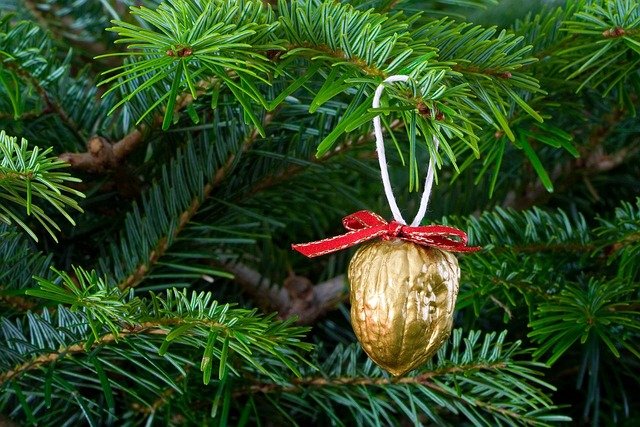
Mention of the Walnut tree in folklore songs sometimes mention it as the “world tree”, … the holy Yggdrasil. Nuts belong on the Christmas dinner table. In Bulgaria, for example, walnuts are a very common thing, and used at Christmas to be given one to each family member and broke open, revealing the fate in the coming year. Hopefully, one would see a white healthy kernel. A black one would be a bad omen. (There is a slavic version of Cinderella, were she receives three walnuts as a gift and opening each reveals the next action or stage of finding her true identity (and love) in form of a specific gown. In other version, those gowns are shaken from a fairy tree.)
Some also say, the parts of the walnut depict a threefold Deity: Christian tradition sometimes mentions the walnut as symbol for the holy trinity: In Celtic and Germanic tradition, there had been several ones, related to rebirth perhaps the Goddess as maiden, mother, and crone, or white, red, and black Goddess (Holle appears in those forms).
Or: Outer, Inner, and Innermost World.
A poem from the Edda (Fjǫlsvinnsmál) tells us about the holy world tree, Yggdrasil. It tells us about fruit of the tree, popular amongst suffering women in particular. The word used is tree fruits – such as nuts and apples.
How to Celebrate the Winter Solstice – Some Traditional Ideas
Some say, the winter solstice as the end of the past year (which is in Celtic tradition at Samhain), is a good time to let go of the old and unuseful, to cleanse oneself and ones own space inside out, and to focus on the coming year.
To do so, you can write down on a piece of paper what you want to let go off, then roll it up and tie with a piece of string …. then set on fire and let burn in a fire proof bowl. Focus on letting go of the old, fearful and what is not useful to you anymore. Combine with cleansing incense.
The “light” aspect is the most important one. As mentioned, – some like to sit in the dark for some time, or the whole night, then light a new flame. Or wait for sun dawn. Which can take some time in the longest night of the year … If you have a fire place, you can include that.
You can make a wheel of the year and use evergreens any way you wish, too, and meditate on that. Focus on the new – on rebirth, on new light. On a spark in the greatest darkness. On how life is being reborn even in the deepest winter. Remember: it is the (dark) Earth Goddess who gives birth to the (light) Sun God. The dark time of the year is the time to turn within, to embrace the calm, and the powers within. Find your creative powers within you.
Incense tip: xx
Tea tip: This tea is for the mind.
Essential oils tip: xxx
Herbs for food tip: You can also bake a wheel of the year. 🙂
Herbs for a cleansing winter solstice bath, to be taken before your ritual:
Fire wood: oak, yew, spruce, fir, juniper
Music tip: Hagalaz rune dance, Frigga’s Web: https://www.youtube.com/watch?v=okA_jgFVvso
Bon Fires & Log Fires & Candles
The jul log from oak or yew or juniper, … was a huge log or actually tree stem, and some say, it used to be decorated with juniper, holly, etc. It then burnt for 12 nights. I tend to believe the other version, and a fresh stem would be very heavy, moist and smoky – and still would last only for a day. A tree stem lasting 12 nights wouldn’t fit into a house. The ashes were used for healing, etc. (Never throw away ashes, they are a great fertilizer.)
Some personal thoughts on the Celebration of the Winter Solstice
To me, the time “between the years”, after Christmas, has always been a special, calm time, providing time and atmosphere for insight. Our modern life is often very hectic, no matter which lifestyle, actually. And thanks to modern culture, the pre “Christmas” time / time before the holidays is especially hectic, stressful and turbulent.
Though I heard that in Bulgaria for example (Orthodox Christian church), it is forbidden in the weeks leading up to Christmas Day to drink alcohol and eat meat.
However: Winter Solstice is a wonderful time for a meditative, timeless evenings or nights, full of intent, letting go of the old, and for inner work. I have taken part at a Germanic ritual in the snow around a fire … passing around hot met … but most of the time, I like to be alone and reflect and be calm.
Light and especially the rekindling of light, the rebirth of light, is central on the Winter Solstice. Some people like to sit all night in the dark and cold, until the first reborn sunlight shows up. Then, all lights are rekindled. In communities without electricity, etc., where survival depended on a fire, and light came from fire, and possibly oil lamps and such before the use of additional candles, … this was especially powerful. Therefore, there are many different traditions, for example that a new kindling log was rekindled / re-ignited by hand, and then passed around to rekindle all fires. Or one big bon fire was lit, and everyone took a torch lit at that fire home to relight the own hearth fire.
Often, certain kinds of wood were essential, or a blend of very specific woods had to used. Many of those traditions might be pure hear say or even fantasy, many might be specific to certain regions or communities. Always keep in mind that traditional pagan rites mean hundreds if not thousands of different traditions, each tribe had its own. You have the big tribal parts of for example Germanic, Celtic, and Slavic people, but those again were split into many many sub tribes, villages, and so on.
I like to refer to works such as the brothers Grimm who collected much original material on Germanic and Celtic customs, to works by Plinius, and other Roman sources, as those were the first who wrote them down. Keep in mind that Celtic, Nordic, Germanic, Slavic, … old pagan people didn’t exactly document what they did. They passed everything on by word of mouth, by learning in person, or in songs and tales. Therefore, I also like to look at the oldest songs and folklore tales I can find, even christianized ones specific to a certain region or even to one place, as those most likely go back to very old traditions. What tales tell about places, especially in nature, in combination with old names, also gives away a lot. For example: what I have written in this article about Frau Holle / Hulda / Hel, is taken from tales from a very specific region in Germany, where I have also visited different places and even current rituals such as the lighting of Easter fires on hills, associated with her. I have been at specific places, where she was reportedly seen in form of a white maiden, and then black crone, and been in her cave with an underground lake, and meditated on what was said locally about that lake, as well as to a different forest lake which was said by local tales to bring the children …
Wicca and other neo-pagan communities are a great try to re-ignite the old flame, but there are so many tradtions mixed, and much half knowledge and fantasy mixed in, so that reliable sources are hard to find.
Therefore: take everything for your inspiration and orientation, and then listen to your own gut feeling. Try to reconnect with Nature herself, and visit special places in nature. Places that seem to have special powers, and spread peace. A walk to take in the energies of the day, is always nice, too, and a small bon fire in nature is a powerful thing. Rituals can be powerful, be careful what you wish for. I had a meditation one winter solstice evening where I made a wheel out of crystals, and evergreens, and tea lights, and meditated on the meaning and balance of “sol” and “is” (as in nordic runes) – on sun or fire, and ice. Next day: I almost set my kitchen on fire, a juicer on the stove went up in flames, as I had turned on the wrong plate, and the whole kitchen was blackened. At the same day, I tried to open the iced shut passenger door of my car – and broke off the whole handle instead of being able to remove or melt the ice. A bit pointless, I know, just saying. Have an intent, and a positive one, focus on the rebirth of light without and within.
In L.V.X.